


Encounters That Change You: Leadership Lessons from the River
The best leadership lessons often come from chance encounters with remarkable people, often in the most unexpected places.
When two people meet and exchange a dollar, both walk away with a dollar. But when they exchange ideas, both are richer. ~ Thomas Jefferson
Most leadership development programs follow a predictable script: classroom exercises, case studies, feedback surveys. But the encounters that truly reshape how we lead rarely arrive on schedule. They show up uninvited, often in wading boots, standing knee-deep in a river.
Over four decades of advising boards and executive teams, I've noticed a pattern. The executives who lead with the most authenticity, empathy, and resilience are often those who've been shaped by encounters outside the corporate world. Encounters that cracked open a new way of seeing people, problems, and purpose. Fly fishing, in particular, has a remarkable way of creating those encounters.
"In everyone's life, at some time, our inner fire goes out. It is then burst into flame by an encounter with another human being." ~Albert Schweitzer
The CEO Who Made a Kid Feel Like a Guide
David Decker tells a story that every leader should hear. As an eager young man working at a Montana fly fishing lodge, he was thrust into service as a guide when the scheduled guide showed up late, wearing flip-flops and a top hat. The lodge owner, furious, turned to the yard boy: "Get your gear. You're guiding today!"
The guest turned out to be the CEO of Burlington Northern Railroad. Decker could have been dismissed, criticized, or simply tolerated. Instead, the CEO fished hard, encouraged the young man, and never once mentioned the late start or the inexperience of his substitute guide. As Decker recalls: "He showed me that real leadership is about making people and situations better, no matter the challenge."
That lesson stuck. Decker and his wife now own and run that same lodge.
There's a profound leadership principle at work here: the best leaders elevate people around them, especially when circumstances are imperfect. They don't demand perfection from others; they create conditions for others to succeed. This is servant leadership in action, not as a theory from a textbook, but lived on a Montana river.
Failure Is an Event, Not an Identity
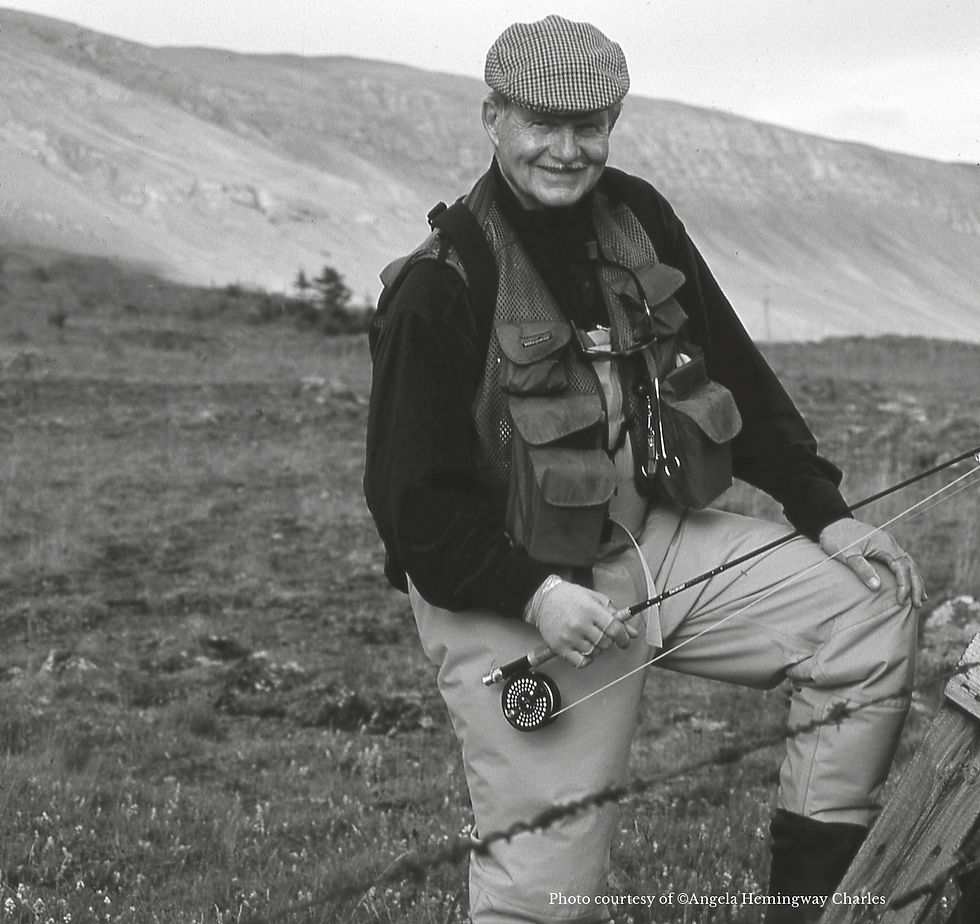
In the summer of 2000, I had the privilege of fishing for Atlantic Salmon in Iceland alongside Jack Hemingway, son of Ernest Hemingway, WWII veteran, conservationist, and one of the finest fly anglers I've ever met.
At a particularly promising pool, I asked Jack what leadership lessons he'd learned from a lifetime of fly fishing. He paused, considered the question carefully, then said something I've never forgotten:
"More than anything else, fly fishing helps me realize that failure is an event, not who I am. I have failed, a lot, in life, and fly fishing. But failure doesn't define me. It just reminds me that there's still more to learn, more to be done about conservation, more fish to catch."
Then he finished tying his fly and made a perfect Spey cast.
In corporate life, leaders often carry their failures like permanent scars. They internalize setbacks as identity markers rather than treating them as data points on a learning curve. Jack Hemingway's perspective is a powerful corrective: separate the event from the person. This is the mindset that builds organizational resilience, psychological safety, and a culture where innovation can thrive.
When Adversaries Become Allies
One of the most extraordinary stories of encounter-driven leadership comes from Michael Marx, who headed the International Boycott Mitsubishi Campaign at Rainforest Action Network. Marx was locked in a bitter fight to stop Mitsubishi Corporation's destruction of old-growth rainforest in Malaysia.
Then he went fly fishing on the Roaring Fork River in Colorado with Dick Recchia, Senior Vice President of Operations for Mitsubishi Motors' US subsidiary. Marx describes what happened: "That day on the Roaring Fork taught me that even in battle, always look for a way to connect with your opponent as a person. Find something in common. As we fished together that day, we both realized the other was a pretty decent person and could be trusted to do the right thing."
The result? A path to resolution that neither adversarial negotiation nor public pressure alone could have achieved. Shared experience builds the trust that positional power never can. For any leader navigating conflict, whether in boardroom negotiations, stakeholder disputes, or cross-functional friction, the lesson is clear: find common ground first. The business strategy can follow.
Respect as a Leadership Practice
Brad Befus learned a leadership lesson by watching an elderly gentleman on the South Platte River spend hours patiently targeting a single trout. The angler didn't rush his casts. He observed, thought carefully about each presentation, and treated the fish with the utmost respect.
When COVID-19 forced Befus to bring back a reduced warehouse crew to keep his online business running, he applied that same principle. Each team member had volunteered to return. They took extra care with every order, and Befus made a point of going out to the warehouse each day, watching them work, and expressing genuine appreciation. "I felt good, they felt good, and I know the customers felt good receiving their product on time."
Respect, patience, and appreciation are not soft skills. They are the foundation of sustained high performance, especially during a crisis. The leaders who retained their best people through the pandemic were not the ones who demanded more; they were the ones who noticed more.
The Stranger on the Bridge
Bern Johnson prefers solitude when he fishes. So when another angler appeared one day while he was swinging for steelhead near a bridge, Johnson cursed under his breath and wished the stranger would leave.
Instead, the stranger walked onto the bridge, spotted a huge steelhead resting in the current, and guided Johnson's casts until he hooked and landed the fish. When Johnson looked up, the man was gone.
"That incident changed my thinking about encountering strangers. I learned that another person could make my fishing trip even better. Both on the river and at work, remember that the next person you meet might lift you up, and you might lift them up too."
This is the essence of collaborative leadership. We often resist the very encounters that could elevate our performance. The most effective leaders remain open to unexpected help, unsolicited perspectives, and the wisdom of people who aren't on their org chart.
When the Student Is Ready
There is an old saying: "When the student is ready, the teacher appears." The encounters described here, from Jack Hemingway's insight on failure to the anonymous stranger on a bridge, share a common thread. They happened because someone was open to learning from an unexpected source. Not from a leadership seminar or an executive coach, but from a fellow human being in a moment of genuine connection.
As Oliver White observed: "I've seen how fly fishing changes the angler, how connecting to wild fish in unspoiled landscapes affects every one of us. Whatever distractions complicate our lives evaporate under the influence of profound waters and untamed fish."
The corporate world could use more of that clarity. The best leadership development isn't always planned; it's encountered. And the leaders who keep growing are the ones who remain students, even when they're already at the top.
The next person you meet might change everything. Stay open.
John R. Childress is a leadership advisor, corporate culture consultant, and bestselling author with four decades of experience working with Fortune 500 and FTSE 250 boards and executive teams.
This is adapted from a chapter in his book: Fly Fishing for Leadership available on Amazon. (www.flyfishingforleadership.com)

His latest book, Culture 4.0: The Future of Corporate Culture (LID Publishing, 2026), explores how organizations must rethink culture for the age of AI and digital transformation. He is co-founder of Senn-Delaney Leadership Consulting Group and Chairman of Pyxis Culture Technologies. Learn more at johnrchildress.com.
#Leadership #LeadershipDevelopment #ServantLeadership #CorporateCulture #ExecutiveLeadership #EmotionalIntelligence #PsychologicalSafety #Mentorship #BuildingTrust #OrganizationalResilience #LeadershipLessons #Culture40 #FlyFishing #FlyFishingForLeadership #LifelongLearning #LeadershipMindset #CEOInsights #PeopleFirst #TeamLeadership #CrisisLeadership


Comments